14-Week Transformation Plan, The Blueprint to Feed Your Inner Athlete
Most people don’t fail a cut because the plan was wrong. They fail because building the plan was a second full-time job. The Athlete Reset hands you the finished blueprint. We bring the food. You bring the training, the sleep, and the discipline.
The concept, in plain English
The Athlete Reset is a 14-week structured cut. Calories taper down gradually, macros stay balanced, real meals do the heavy lifting. You don’t weigh chicken, you don’t calculate ratios, you don’t scroll a tracking app at midnight wondering if that handful of nuts ruined your week. Every dish in the plan is a real Local Foodz menu item, with macros captured live from our Customized Meals builder. What we say is in the meal, is in the meal.
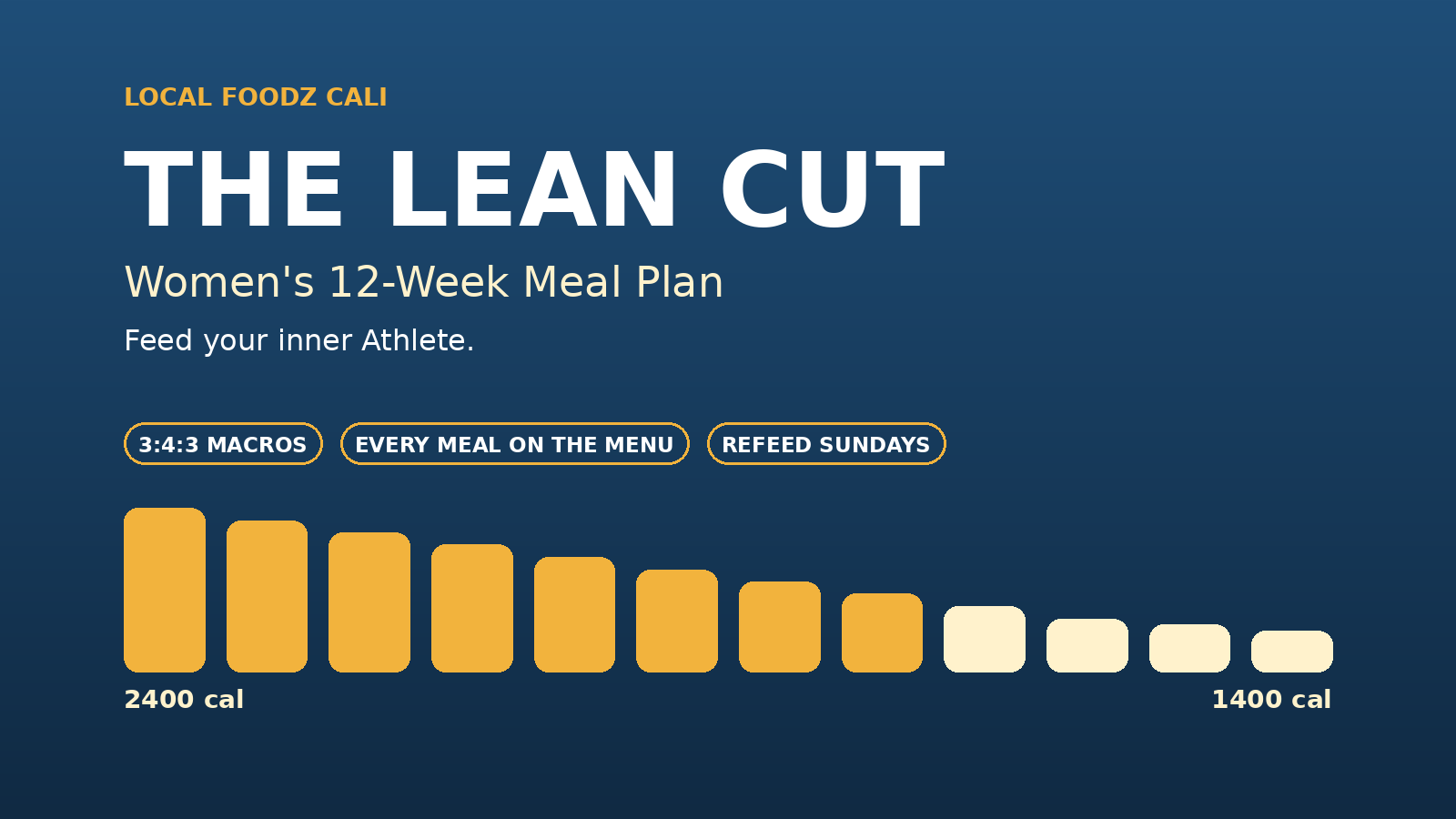
The plan is organized into 14 calorie targets, week by week. You start at the week that matches your current intake, then taper down one notch at a time.
- Weeks 1 to 3: 3,500 to 3,100 calories. Lean gain or maintenance for big athletes.
- Weeks 4 to 6: 2,900 to 2,500 calories. Active maintenance, the start of the cut for most people.
- Weeks 7 to 9: 2,300 to 2,100 calories. The middle of the cut. Fat starts coming off.
- Weeks 10 to 14: 2,000 down to 1,700 calories. The refeed block. Six low days, one refeed day at 2,800 calories to keep hormones and training intact.
Drops between weeks are 100 to 200 calories. That is intentional. A 500 calorie jump from one week to the next does two things, it crashes your metabolism and it makes the hunger unbearable. A 150 calorie step is something your body and your appetite barely notice.
The macro split: 3 parts protein, 4 parts carbs, 3 parts fat
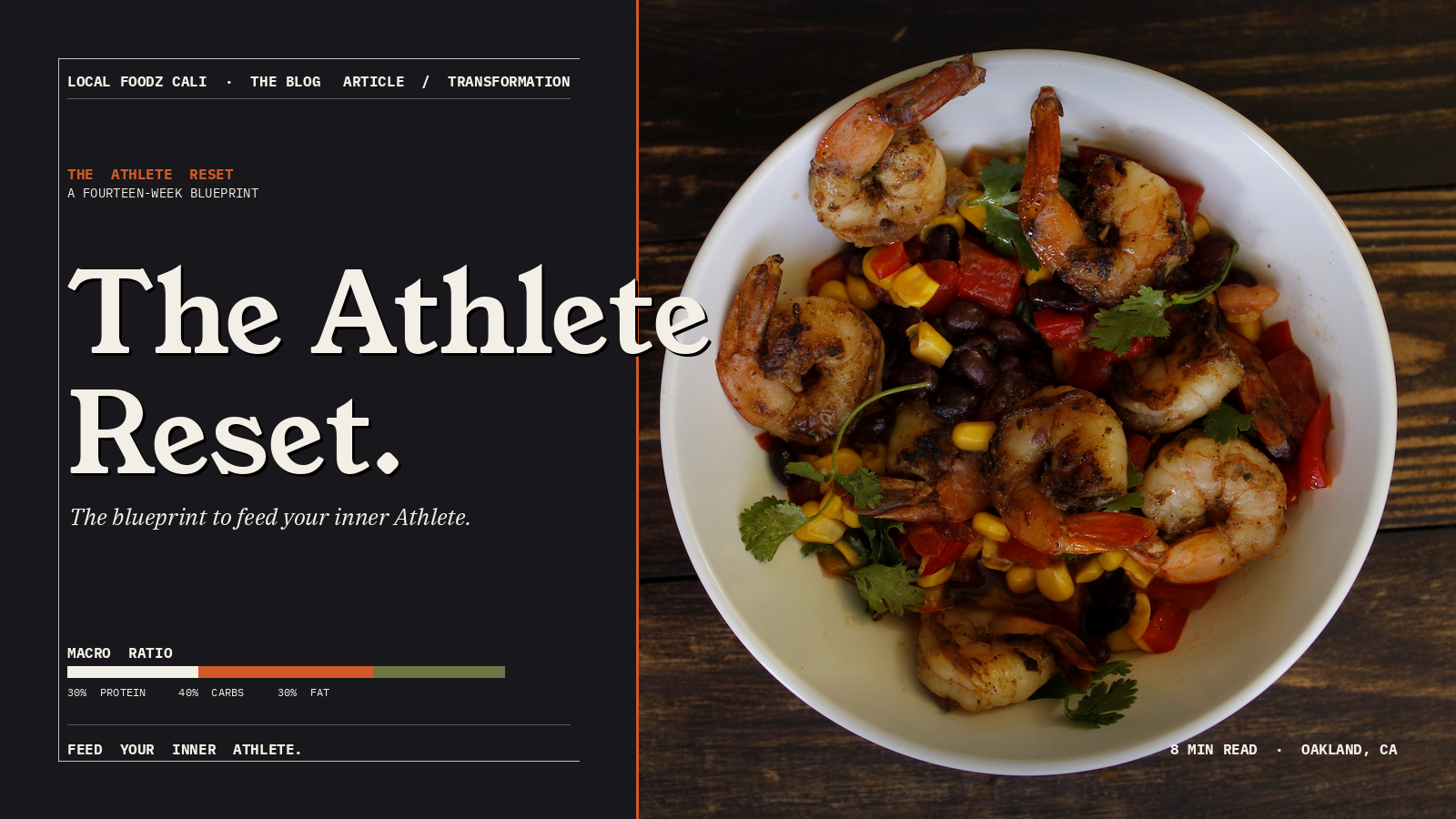
Every week of The Athlete Reset is built on the same macro ratio: 30 percent of calories from protein, 40 percent from carbs, 30 percent from fat. That is a 3:4:3 split, and it holds whether you are eating 3,500 calories in week 1 or 1,700 in week 14.
The math is simple. Take your weekly calorie target. Protein in grams is calories times 0.30 divided by 4. Carbs in grams is calories times 0.40 divided by 4. Fat in grams is calories times 0.30 divided by 9. We do that math for you, week by week. The result is a plan where the macros scale with your appetite, not against it.
- Week 1, 3,500 cal: 262 g protein, 350 g carbs, 117 g fat
- Week 6, 2,500 cal: 188 g protein, 250 g carbs, 83 g fat
- Week 10, 2,000 cal: 150 g protein, 200 g carbs, 67 g fat
- Week 14, 1,700 cal: 128 g protein, 170 g carbs, 57 g fat
Why 3:4:3 and not the old bodybuilding 40-40-20 or a keto 5-15-80? Because 3:4:3 is the ratio that finishes the program. Carbs at 40 percent keep training output high, which is the part of a cut where most plans die. Protein at 30 percent is enough to protect muscle without becoming the only thing you taste at every meal. Fat at 30 percent keeps you satiated and your hormones stable. It is the ratio the research keeps coming back to for active people in a deficit, and it is the ratio that, in our experience, people can actually stick to for 14 weeks.
Why the last 5 weeks have a refeed day
After 9 weeks in a deficit, your body has noticed. Leptin drops, thyroid output slows, training feels heavier, sleep gets worse. One refeed day per week at 2,800 calories is a controlled spike that resets some of that. It is not a cheat day. There is no point in earning a refeed and then spending it on three pints of ice cream. You still eat real food, just more of it, with the same 3:4:3 split.
Food is one of five pillars. The plan only gives you one.
The Athlete Reset solves the food problem. The other four pillars are on you. Skip one of them and the plan still works, just slower. Skip two of them and you will plateau no matter what your calories say.
Pillar 1: Water
Target is roughly 0.5 to 1 ounce of water per pound of bodyweight per day. A 180 pound athlete is in the 90 to 180 ounce range, call it a gallon and don’t overthink it. Drink most of it before 6pm so it doesn’t wreck your sleep.
- 16 to 20 oz first thing in the morning before coffee
- 8 to 16 oz during training, more in heat
- Add a pinch of salt or an electrolyte tab on low-carb cut weeks (12 through 14). Headaches and brain fog in week 13 are almost always sodium, not calories
Coffee and tea count toward the total. Soda doesn’t. Alcohol cancels out the water it came with and then some.
Pillar 2: Sleep
7 to 9 hours. Same window every night. This is the most under-rated lever in the entire program. Sleep is when growth hormone fires, when muscle rebuilds, when the appetite hormones leptin and ghrelin reset. Cut your sleep to 5 hours and your hunger goes up roughly 20 to 25 percent the next day, your cortisol stays elevated, your training output drops. You can run a clean cut on 5 hours of sleep, but you are paying for it twice.
- Room cool (65 to 68 degrees) and dark
- Phone out of the bedroom or in airplane mode
- Caffeine cutoff 8 hours before bed (sooner if you are sensitive)
- Last meal 2 to 3 hours before sleep so digestion doesn’t fight rest
Pillar 3: Cardio progression
Cardio is not punishment for the food you ate. It is a separate training input that builds your engine and helps the cut work without you eating less and less. The progression matters more than the volume.
Weeks 1 to 4
- 2 to 3 sessions a week, 20 to 30 minutes each
- Zone 2 effort. That is the pace where you can hold a conversation in full sentences but not sing
- Walking on incline, easy bike, easy row, easy swim. Anything that holds the zone
- Daily steps: 8,000 to 10,000 baseline
Weeks 5 to 9
- 3 to 4 sessions a week, 30 to 40 minutes each
- Add 1 HIIT session: 8 to 12 rounds of 30 seconds hard, 90 seconds easy
- Daily steps: 10,000 to 12,000
Weeks 10 to 14
- 3 sessions of Zone 2 (40 to 45 minutes) plus 2 HIIT sessions (10 to 15 minutes)
- On refeed days, do your hardest cardio session of the week. Take advantage of the fuel
- Daily steps: 12,000 plus
If you have to choose one, choose Zone 2. It burns fat without raising cortisol, it doesn’t crush your recovery, and it stacks under your lifting without stealing from it.
Pillar 4: Lifting progression
If you are cutting and not lifting, you are losing muscle. If you are lifting like it is week 1 of a hypertrophy block during week 13 of a cut, you are setting yourself up to fail. Progressive overload still matters, the rate just changes.
The lifts that matter
- Squat (back, front, or goblet, pick what your body tolerates)
- Deadlift or Romanian deadlift
- Bench press or push-up variation
- Overhead press
- Row (barbell, dumbbell, or cable)
- Pull-up or lat pulldown
Hit each one or two of these per session, 3 to 5 sessions a week. Track every set in a notebook or an app. If you don’t track, you are not progressing, you are just lifting.
Weeks 1 to 6
- Aim to add 2.5 to 5 pounds to your main lifts each week, or 1 rep at the same weight
- Hypertrophy ranges: 6 to 12 reps for upper body, 8 to 15 for legs
- 3 to 4 working sets per exercise
Weeks 7 to 11
- Progression slows. Match last week’s weight before adding
- Drop volume slightly if recovery suffers (2 to 3 working sets instead of 4)
- Keep intensity, drop accessories before main lifts
Weeks 12 to 14
- Maintenance mode. Do not chase PRs in a 1,700 calorie week
- Hit 80 to 85 percent of your top working weight, full reps, clean form
- Your job in the last 3 weeks is to KEEP your muscle, not build new muscle. That comes later
Sleep, food, and recovery are what allow lifting to keep working in a deficit. Without them, you are just digging a hole.
What you can actually expect, by adherence
Adherence is the variable nobody likes to talk about. The plan can be perfect, but a perfect plan executed at 60 percent gives you 60 percent results, at best. Here is the honest spread, based on the typical person doing the typical version of this program.
100 percent adherence
Hits the calorie target every day. Lifts on schedule. Cardio progression on schedule. Sleeps 7 plus hours. Stays hydrated. This is the demo athlete, the one who is genuinely trying to peak. Realistic 14-week range: 18 to 25 pounds of fat lost, visible abs by week 14 for most people starting under 18 percent body fat, all main lifts at or above their week 1 numbers. This level of adherence is rare. Honor it when you see it.
90 percent adherence
Misses the calorie target once or twice a week, usually high. Misses a workout every other week. Skips cardio on a Friday or two. This is the realistic ceiling for committed people with jobs and families. Realistic 14-week range: 14 to 20 pounds of fat lost, clear visual change in the mirror, lifts mostly maintained, energy and sleep generally improving by week 8. This is the level that most people who finish the program actually hit.
80 percent adherence
Hits the plan most days. Has a weekend or two that slide. Misses cardio when work runs late. Sleep is inconsistent. Realistic 14-week range: 8 to 14 pounds of fat lost, noticeable change in waist and face, lifts maintained, clothes fit better. This is still a real result. Most people would be thrilled with this outcome and never get it because they think 80 percent is failure. It is not. 80 percent finished is infinitely better than 100 percent unstarted.
Below 80 percent
Mostly maintenance. Some fat loss in early weeks that levels off as adherence slides. The plan is not magic, and we will not pretend otherwise. If you are at 60 percent adherence, the answer is not more aggressive calories, it is fixing your habits first. Drop back to the maintenance weeks (4 through 6), stack sleep and water and steps until those are automatic, then come back to the cut.
Set yourself up before you start
You do not need a home gym to run The Athlete Reset. You do need a tiny kit of tools that turn the program from guesswork into data, plus the right guidance on any supplementation. Order the gear now so it arrives before your start date, and book the conversations on supplementation in the same week.
1. A reliable digital scale with an app
Daily weighing is the backbone of the measurement protocol. The scale you used in 2015 in your bathroom is probably fine for go/no-go, but a modern smart scale gives you something far more useful: it logs every reading automatically and computes your weekly average for you. No daily logging by hand, no notebooks, no forgetting. The app remembers.
Look for a scale with Bluetooth or Wi-Fi sync, an iOS or Android app, and at minimum a 7-day moving average view. The good ones also estimate body fat percentage, muscle mass, body water, visceral fat, and bone density via bioelectrical impedance. Those numbers are not laboratory accurate, but they are directionally honest week over week, which is what you actually need. Watching body fat percent drop while lean mass holds steady is a much more useful signal than the scale weight alone.
- Budget pick (around $35): Renpho Smart Scale, syncs to the Renpho Health app
- Mid-tier (around $50 to $80): Etekcity Smart Scale, Wyze Scale X, Eufy Smart Scale
- Premium (around $130 to $300): Withings Body+ or Body Comp, syncs with Apple Health and Google Fit
Place the scale on hard floor (not carpet or rug, the readings drift). Step on at the same time every morning, same conditions: just after waking, after the bathroom, before any food or water, naked or in the same minimal layer. Same scale, same spot, same time, every day.
2. A soft cloth measuring tape
Daily weight tells you what changed. Weekly tape measurements tell you where. In a real cut, there will be weeks where the scale barely moves but your waist drops half an inch. That is body recomposition, and the only way to see it is the tape.
Get a soft cloth or plastic tape, 60 inches long, the kind a tailor would use. Not a stiff metal carpenter’s tape, those do not contour to the body and you will read wrong every time. Around $5 on Amazon.
- MyoTape Body Tape Measure (around $8) — has a retractable button and a fixed-tension feature so you don’t over-tighten
- Any basic seamstress tape, 60 inches, will work — Singer, Dritz, generic
Once a week, same morning as the weigh-in, take five measurements: waist at the navel, hips at the widest point, chest at the nipple line, mid-thigh, and the peak of one flexed bicep. Write them in a phone note or in the same scale app if it supports manual entry. Five numbers, four minutes. That data set is what catches the wins the scale hides.
3. A large refillable water bottle
Water target is roughly half an ounce to one ounce per pound of bodyweight per day. For a 180 pound athlete that is 90 to 180 ounces, somewhere around a gallon. You will not hit that without a vessel you can see. A glass at a time disappears into background. A 32 to 64 ounce bottle on your desk, refilled twice, finishes the job before dinner.
Get something insulated, leak-proof, and sized so the math is obvious. A 32 oz bottle filled three times equals 96 oz. A 64 oz bottle filled twice equals 128 oz. Counting refills is easier than counting sips.
- Stanley Quencher 40 oz tumbler (around $40) — insulated, handle, fits a car cup holder
- Hydro Flask 32 or 40 oz (around $45 to $50) — keeps cold for 24 hours
- Owala FreeSip 32 or 40 oz (around $30) — flip-top spout, easier on the go
- Nalgene 32 oz (around $15) — wide mouth, durable, the bargain pick
Add a pinch of salt or an electrolyte tab once a day during the cut weeks (12 through 14) when sodium drops. Headaches and brain fog in week 13 are almost always sodium, not calories. LMNT, Liquid IV (the zero-sugar version), or any electrolyte powder works.
4. Supplementation, where it actually helps
The Athlete Reset is built so that food does the heavy lifting. Most people who eat real meals in the right macros do not need a cabinet full of pills. But there are real, individualized gaps that supplementation can fill: low vitamin D from indoor work, low iron in athletes who menstruate, low magnesium under heavy training, creatine for strength athletes, protein powder when a travel day blows up the schedule.
We do not make supplement recommendations from this page because we cannot see your blood work, your training, or your medical history. Go to a qualified professional who can:
- Your trainer or strength coach for performance-oriented supplements (creatine, protein, intra-workout, etc.)
- Your registered dietitian or doctor for nutritional gap supplements (vitamin D, iron, magnesium, omega-3, etc.) — ideally with a recent blood panel in hand
- Our retail partner, San Mateo Sports Nutrition, for product selection, third-party-tested brands, and walk-in advice from staff who know the field
Bring your blood panel, your training schedule, and a list of any medications. Walk out with a short, specific list — not a shopping cart. The right supplement stack for The Athlete Reset is small, targeted, and personalized to you.
How to use this as your personal blueprint
The Athlete Reset is a template, not a prescription. You pick your starting week based on your body and your current intake. Here is the math.
Download the following spreadsheets to track your statistics:
Step 1: Estimate your maintenance calories
The simple version uses the Mifflin-St Jeor formula. You need your weight in kilograms (pounds divided by 2.2), height in centimeters (inches times 2.54), and your age.
- Men: 10 × kg + 6.25 × cm minus 5 × age + 5 = BMR
- Women: 10 × kg + 6.25 × cm minus 5 × age minus 161 = BMR
Multiply your BMR by an activity factor to get maintenance:
- 1.2 desk job, no training (sedentary)
- 1.375 light training 1 to 3 days a week
- 1.55 moderate training 3 to 5 days a week
- 1.725 hard training 6 to 7 days a week
- 1.9 athlete or physical labor plus training
Step 2: Pick your starting week
Find the week whose calorie target is 300 to 500 calories below your maintenance. That is your starting week. From there you taper weekly as written.
Worked examples
30 year old man, 5’10” (178 cm), 180 lbs (82 kg), moderately active. BMR = 1,765. Maintenance at 1.55 = 2,735. Cut at 300 below = 2,435. Start at Week 6 or 7 (2,500 to 2,300).
35 year old woman, 5’6” (168 cm), 150 lbs (68 kg), moderately active. BMR = 1,386. Maintenance at 1.55 = 2,148. Cut at 300 below = 1,848. Start at Week 12 (1,800).
28 year old man, 6’2” (188 cm), 220 lbs (100 kg), hard training 6 days a week, wants a lean recomp. BMR = 2,065. Maintenance at 1.725 = 3,562. Cut at 300 below = 3,262. Start at Week 2 (3,300).
If your math puts you between two weeks, start at the higher calorie one. You can always taper faster, you cannot easily go back up.
Step 3: Trust the 3:4:3 split
Unlike older plans that fix protein at a single number, The Athlete Reset uses a calorie-based ratio. As your calories drop week by week, your protein, carbs, and fat all step down together at the same 30 / 40 / 30 ratio. You don’t have to recalculate anything. Pick your starting week, follow the plan, and the macros are already in proportion.
If your bodyweight is on either end of the spectrum (under 130 pounds or over 230) and the protein number in your starting week feels too high or too low, talk to a dietitian or coach about a custom split. For most adults in the 140 to 220 pound range, the 3:4:3 ratio at the calorie targets in this plan is in the sweet spot for protecting muscle while keeping training output up.
To top up macros on any day, the Customized Meals page at localfoodz.co/menu/customized-meals lets you build a precise meal: pick a protein (4 to 8 oz of Sousvide Chicken Breast, Garlic Steak, Ginger Soy Tilapia, etc.), add a side (White Rice, Quinoa, Roasted Veg Medley), pick a sauce. Macros are displayed live in the builder.
Step 4: Measure right, adjust right
This is where most people lose the plot. They step on the scale, see a 2 pound jump from yesterday, panic, eat less, train less, sleep worse. Daily weight is noise. Sodium, water, glycogen, fiber, and what time you ate last night can swing the scale 3 to 5 pounds in either direction overnight. The signal is hidden inside that noise, and the only way to see it is to measure a lot and average it out.
Weigh in daily, compare weekly averages
Step on the scale every single morning. Same time, same conditions: right after you wake up, after you’ve used the bathroom, before any food or coffee or water, naked or in the same minimal layer. Write the number down. Don’t react to it.
At the end of the week, take the seven daily weights and average them. That weekly average is your real bodyweight. Compare this week’s average to last week’s average. That comparison is the only one that matters.
- Daily weight: noise. Ignore it day to day.
- Weekly average: signal. This is your trend.
- 4-week rolling trend: the truth. Use this to decide whether to step down a week, hold, or back off.
Example. Daily weights for the week: 184.2, 182.8, 183.4, 184.0, 182.1, 181.6, 182.5. Looks chaotic. Average = 182.9. Last week’s average was 184.4. You lost 1.5 pounds. That is exactly on target. The 184.2 day was not a failure, the 181.6 day was not a victory. The average is what is true.
Tape measure once a week
Pick one day a week, same morning, same conditions as the weigh-in. Take five measurements with a soft tape, not pulled tight, not loose. Write them down.
- Waist at navel
- Hips at widest point
- Chest at nipple line, arms relaxed at sides
- One thigh, mid-thigh, halfway between hip crease and knee
- One upper arm, flexed, at the peak of the bicep
Measurements catch what the scale misses. In a serious cut, you will see weeks where the scale barely moves but the waist drops half an inch. That is body recomposition: fat down, muscle holding. It is the result you actually want, and the tape is the only thing that will tell you it’s happening.
Photos once a week
Same day as the tape and the weekly average. Strip down to underwear or training shorts. Stand in the same spot, same lighting, same time of day, phone at the same height (a small tripod or a stack of books works). Take three shots: front, side, back. Relaxed, not flexed. Save them in a folder by date.
The mirror lies to you every day because you see yourself every day. The camera does not. At week 8 you will look back at week 1 and see a different person, even if the scale only moved 6 pounds. The photos are the receipt.
How to use the data to adjust
- Weekly average dropped 1 to 2 lbs: on track, step down to the next week as written
- Weekly average dropped 3 lbs or more: too fast, hold the current week or step UP one. Aggressive cuts cost muscle and crash adherence
- Weekly average flat for 2 weeks in a row, tape measurements also flat: legitimate stall, step down to the next week
- Weekly average flat but tape measurements are dropping: recomp, you are losing fat and holding water/muscle. Stay the course, do not panic-cut
- Weekly average UP for 2 weeks: stop, audit your adherence honestly before changing the plan. The plan didn’t break, life did. Fix the leak (usually weekends or alcohol) before touching calories
Why this is worth it
Most diet plans break for the same reason. They force you to track every gram of every meal, cook it yourself, and stay motivated for 14 straight weeks. Three weeks in, you are eating cold rice out of a Tupperware while doing dishes and wondering why you signed up. By week 6, the plan is in the trash and you are ordering Thai.
The Athlete Reset removes the part of the process that breaks. The macros are mindless. The meals are real. You don’t cook, you don’t weigh, you don’t measure. You open a container, you heat, you eat. Every meal has been built around the calorie and protein math, by us, in advance.
That is the actual value. Not the meal, the absence of friction around the meal. The decision fatigue is gone. The grocery store trips are gone. The clean-up is gone. The 11pm “what am I eating tomorrow” spiral is gone. What is left is the work that actually moves the needle: lifting hard, sleeping deep, walking more, drinking water, showing up.
Feed your inner Athlete. We do the meals. You do the work. The plan does the rest.
Disclaimer
Local Foodz Cali is a meal preparation company. We are not licensed dietitians, registered nutritionists, certified personal trainers, or medical professionals. The Athlete Reset plan is structured to mimic the macro and progression framework a qualified professional would build, but it is not personalized medical, nutritional, or training advice. We do not know your medical history, your training history, your blood work, your medications, your hormonal status, or your individual circumstances.
Before starting The Athlete Reset, please consult with a licensed physician, registered dietitian, or certified strength and conditioning coach, especially if you are pregnant or nursing, recovering from injury or surgery, managing a chronic condition (including but not limited to diabetes, thyroid disease, cardiovascular disease, eating disorders, or kidney disease), under the age of 18, or taking medications that interact with caloric intake or training volume.
Macros published on the plan are captured live from the localfoodz.co builder. Actual macros may vary based on portion variability, recipe updates, and selected customization. The plan assumes you adjust based on your own results, your own body, and your own professional medical guidance.
Ready to start
The full 14-week Athlete Reset, Transformation Plan workbook is available below. Pick your starting week, browse the meal plan, lock your week, and order. We deliver, you heat, you train, you reset.
Feed your inner Athlete.